- Meta Ads
- homeowners
- method
Meta Ads or Google Ads: which to choose when you sell to consumers
Google captures demand that already exists, Meta goes and finds it among people who were not thinking about it. How to choose, depending on what you sell.
Published on · Joh · 6 min read
The question comes up on almost every first call: Meta or Google? The short answer fits in a sentence. It depends on what your customers do before they buy.
What each one does
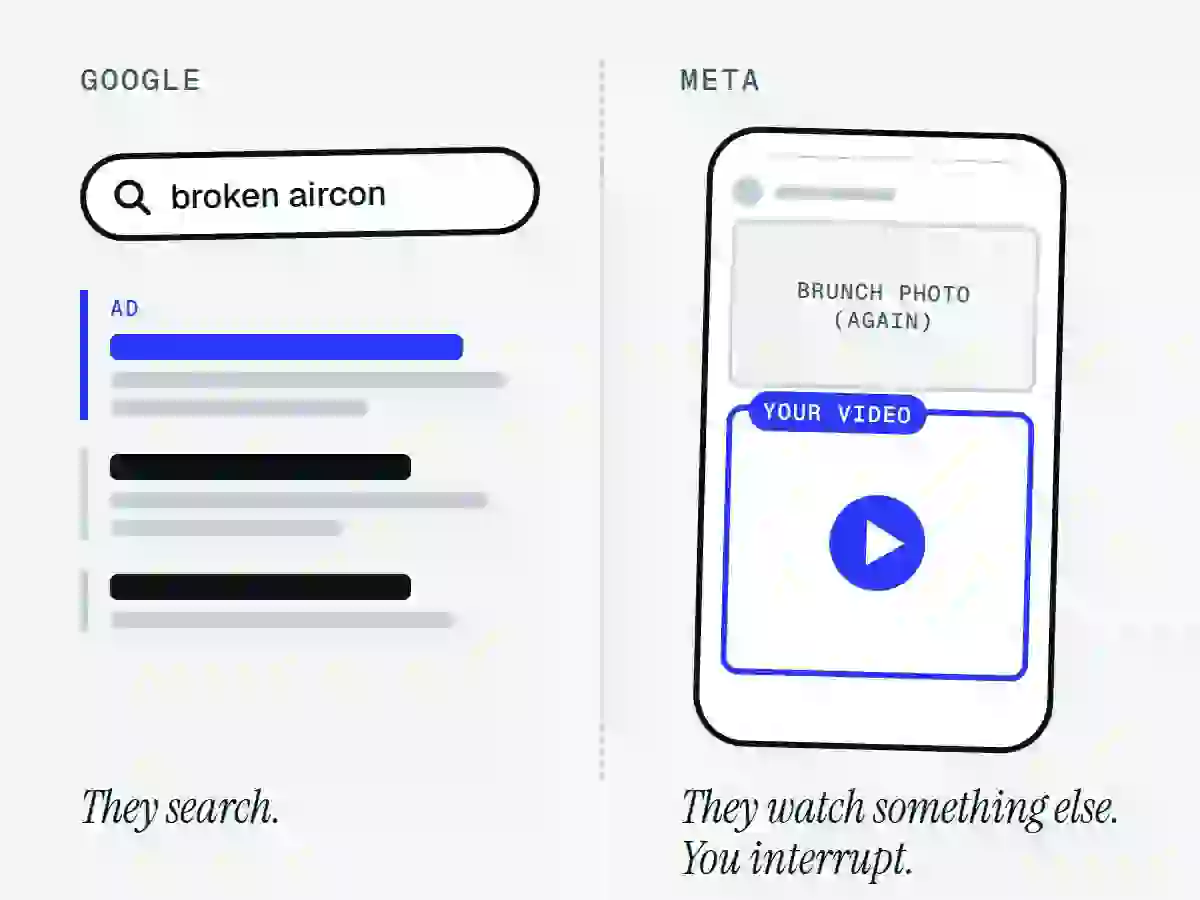
Google puts you in front of someone who is searching. The person typed what they want, and you appear at that moment. The demand already exists, you come and take it.
Meta (Facebook and Instagram) puts you in front of someone who is doing something else: watching videos, looking at photos, catching up with friends. You interrupt them. The demand is not spelled out, so you wake it up or bring it about.
Both work. They just do not answer the same situation.
When Google comes first
When the purchase is triggered by a problem that has to be fixed fast: a leak, an air conditioner failing in the middle of summer, a jammed lock. The person searches, and wants a name and a phone number, not inspiration.
The limit is volume. It is set by the number of people who type your query in your area. If few people type it, you hit a ceiling quickly, whatever your budget.
When Meta comes first
When the purchase is a project or a wish: a kitchen, a pool, a renovation, a veranda. Some buyers type nothing until they have seen a finished job that gives them the idea. Meta reaches them before the search, with a video that shows the result.
I run both. For a business that sells projects to consumers, I often start with Meta. For an emergency repair business, I start with Google. And sometimes the two work together from day one. How I run Google Ads.
They cross over more than you think
Someone sees your video on Instagram, does not click, then types your name into Google an hour or a day later. If your Google listing is empty or your site is confusing, that contact is lost, and neither tool is to blame.
Before spending on either, check what shows up when someone searches your name.
Three questions to decide
- Do your customers search for what you sell before buying, or do they discover it? Type the query into Google yourself: if the suggestions are thin, search alone will not give you volume.
- Does your argument show on video? A before and after, a job site, a face, a place: what can be shown suits Meta.
- Is your buying cycle long? On a purchase worth several thousand euros, the person compares for weeks. You need to be present several times, not only at the moment of search.
The cost-per-click trap
The two platforms are often compared on the price of a click. It is a poor comparison: an expensive click that brings someone who has decided is worth more than a cheap click that brings a browser.
The only honest comparison is the cost of a signed customer, worked out all the way to the sale. The calculation is set out here.
Further reading: What Meta Ads budget to plan and How to structure a Meta campaign to get enquiries.
Torn between the two? . We look at what your customers do before they buy, and see which comes first in your case, or whether both have a place.