- Meta Ads
- homeowners
- budget
What Meta Ads budget to plan when you sell to homeowners
The minimum viable budget, how to split it between prospecting and retargeting, and when to raise it, for a business that sells to homeowners.
Published on · Joh · 8 min read
Most businesses that give up on Meta did not fail because of the platform. They spent too little, for too long, to ever get enough data.
Here is how to set a budget that stands a chance.
The minimum viable budget
The calculation runs backwards, starting from the number of conversions the algorithm needs in order to learn.
Meta needs roughly 50 conversions per week per ad set to leave its learning phase. When you sell to homeowners, that volume is reachable on the quote requests themselves, provided the budget keeps up. While you are far from it, you optimise on a more frequent event further upstream: a form started, a call placed from the ad, a full video view.
Be wary of public benchmarks: the cost of an enquiry varies fivefold between servicing an air conditioning unit and installing a pool. The only benchmark that really counts is your own account, measured over your first weeks of running ads. [Cost per enquiry ranges by trade, TO BE CONFIRMED]
With a cost per lead of €120 and a target of 10 leads a month, you need €1,200 of monthly ad spend. Below €1,000 to €1,500 a month, you will not have enough data to decide anything: you will be paying for uncertainty.
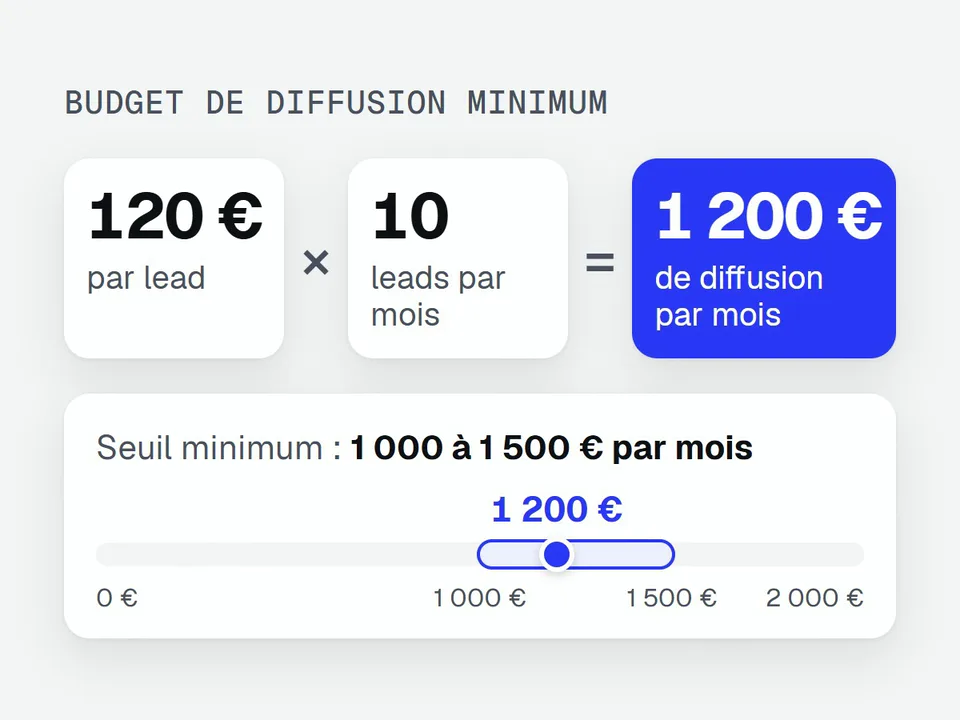
That threshold is not a universal rule. In a niche market with a very high order value, a smaller budget can be enough. In a competitive market, you will have to go higher.
How to split the budget
A split that works well to get started:
| Tier | Share of budget | Purpose |
|---|---|---|
| Cold prospecting | 60 % | Introduce your offer to your audience |
| Retargeting visitors and video viewers | 30 % | Catch those who showed interest |
| Tight retargeting (key pages, abandoned forms) | 10 % | Convert the warmest |
Retargeting is structurally the profitable part, but it cannot exist without prospecting: with no incoming audience, there is nobody to retarget. That is the most common mistake: putting everything into retargeting because the numbers look good there, then watching the machine run out of steam in three weeks.
A deeper point about what Meta is for: the platform performs best when it goes back to people who already know you (site visitors, viewers of your videos, quotes left unanswered) rather than on pure cold prospecting. If you already have incoming traffic from search or word of mouth, Meta amplifies it. If there is nothing, demand has to be created first.
How long before you judge
Three stages:
Two weeks. You know which creative holds attention. You still know nothing about the quality of the contacts.
One month. You have a reliable cost per lead and you can cut the ads that serve no purpose.
Three months. You know what Meta actually brings back, because the first appointments have had time to turn into something.
Cutting before a month is the surest way to lose the money already spent. Plenty of advertisers stop at 30 days, at the precise moment the algorithm is starting to work out who to aim at.
When to raise the budget
Three conditions, all three of them:
- Your cost per appointment has been stable for at least three weeks.
- Those appointments turn into customers at a rate you know.
- You have new creatives ready to take over.
The third condition is the one people forget. Raising the budget on the same videos wears them out faster: the same audience sees them more often, engagement drops, and the cost climbs.
Go up in steps of 20 to 30 % every three or four days. A sudden jump sends the campaign back into its learning phase.
The production budget, often forgotten
An ad budget with no creative budget runs dry. Ads wear out, especially on a narrow local audience where the same people see you several times a week.
Plan on a monthly refresh: three to five new videos a month is enough for most businesses. Half a day of filming every two months feeds that rhythm comfortably, especially by cutting each take into several hooks.
What you need to be able to track
A budget only means something if you measure the right thing. The numbers that count:
- Cost per appointment obtained, not per form filled in
- The share of appointments actually kept
- The rate at which they become customers
- The full customer acquisition cost
- Revenue attributed, at 90 and 180 days
Views, clicks and impressions are there to diagnose a campaign, not to decide whether it pays.
Going further: What a video ad costs on Meta and What a signed job really costs. When it works: how to scale your ads.
Unsure about your budget? . We look at your current numbers and set an amount that makes sense for your market.