- AI video
- filming
- ad creative
AI-generated video or a real shoot: how to choose for your ads
Cost, turnaround, trust, volume of tests: what each approach actually brings, and how to combine them without losing credibility.
Published on · Joh · 8 min read
Ever since generated video became usable in advertising, the question comes up on every first call: is there still any point in filming?
Short answer: yes, but less often. Here is how to decide, criterion by criterion.
What each approach brings
| Criterion | Real shoot | AI generation |
|---|---|---|
| Cost of one more variant | high, you have to film again | low, you regenerate |
| Time to go live | a few days | a few hours |
| Credibility with a homeowner | strong | variable |
| Suited to customer testimonials | yes | no |
| Suited to testing angles | heavy | excellent |
| Reusable for a long time | yes | yes |
| Risk of the audience rejecting it | low | real if done badly |
The criterion that settles it: trust
Someone letting a company into their home is taking a risk: they put money up front for work they will not see finished for weeks. They are buying the person as much as the service. When your face, your voice and your workshop appear on screen, you answer an unspoken question: do these people actually exist?
A fully generated video does not answer that question. It can explain, demonstrate, illustrate; it cannot reassure anyone that you exist.
In practice:
Film anything that starts a relationship: the owner introducing themselves, customer testimonials, a tour of the premises, a demonstration of hands-on skill, an answer to a sensitive objection.
Generate anything that explains or illustrates: setting up a problem, a software demonstration, a before-and-after comparison, animated figures, the same idea played out in several contexts.
The criterion that changes everything: volume of tests
This is where generation takes a real lead.
In advertising you do not know in advance which angle works. The "save time" angle and the "stop losing customers" angle can perform three times apart from each other, with nobody able to predict it.
Testing ten angles by filming means a day of shooting and a serious budget. Testing ten angles by generation means an afternoon of writing and editing.
The method that follows: generate to find the angle, film to exploit it. Once an angle is backed by the numbers, it justifies a proper shoot that becomes your main ad for several months.
What gives a generated video away
If you do generate, these points make the difference between a credible ad and one the audience rejects:
Hands and faces in close-up. Those are the areas where the flaws show. Favour wide shots, shots of objects, screen recordings.
Movement that is too smoothly continuous. A camera gliding without the slightest bump signals generation. Add a little instability in the edit.
The absence of texture. Light, consistent grain across every shot does an enormous amount for credibility.
A synthetic voice pretending otherwise. A generated voice-over trying to pass for human rings false. Either you record your own voice, or you own a neutral voice-over with subtitles.
Mixing the two within a single shot. Alternating real and generated shots works well. Compositing generated elements into a real shot almost always shows.
Should you tell the audience?
My view: yes when it is visible, no when it adds nothing.
A discreet note on an obviously generated video avoids any sense of deception and shows technical command. Conversely, flagging that a background was retouched interests nobody.
The rule I hold myself to: nothing generated may suggest an event that did not happen. No fake customer testimonial, no fake premises, no fake team.
The combination that works
For a business starting out in video advertising:
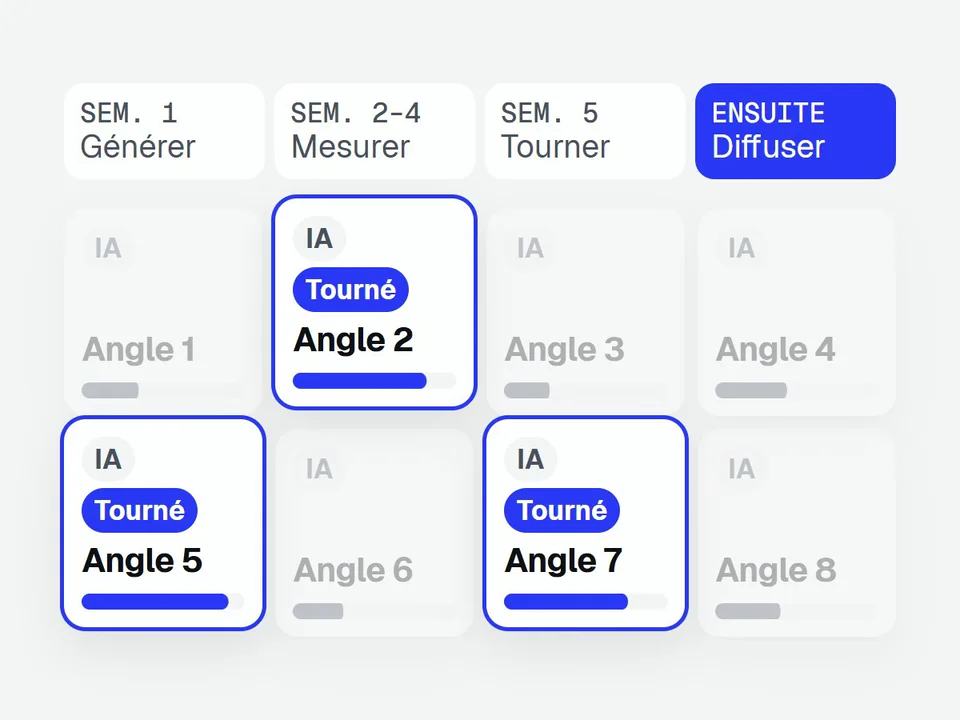
- Week 1: generate six to ten variants testing different angles. Low production cost, quick to go live.
- Weeks 2 to 4: run them, measure, identify the two or three angles that hold attention and bring contacts in.
- Week 5: half a day of filming on the angles that held up: the owner to camera, shots of the work, possibly a customer testimonial.
- After that: the filmed videos become the main ads, and the generated ones keep testing new angles.
You invest in filming once you know what to film. That is the whole point.
The all-AI trap
A business that only produces generated material ends up looking like every other one. The same tools produce the same aesthetics, and your audience scrolls past dozens of ads a day.
What is unique to you (your face, your premises, your customers, the way you talk about your trade) cannot be generated. It is precisely what sets you apart in a saturated feed.
Going further: Why your ads cost more and more and What a video ad costs on Meta. To put it into practice: making a video ad with AI.
Not sure where to start? . We look at your business and decide together what has to be filmed and what can be generated.