- Meta Ads
- budget
- video
What a video ad costs on Meta in 2026
Production, ad spend, management: the detail of what a Meta video ad really costs in 2026, with the market benchmarks to compare.
Published on · Joh · 9 min read
Asking "what does a video ad cost on Meta" is like asking what a car costs. The answer depends on what you put in it. Unlike a car, though, an ad has three quite separate cost lines, and most quotes only show one of them.
This article covers all three, with 2026 market figures.
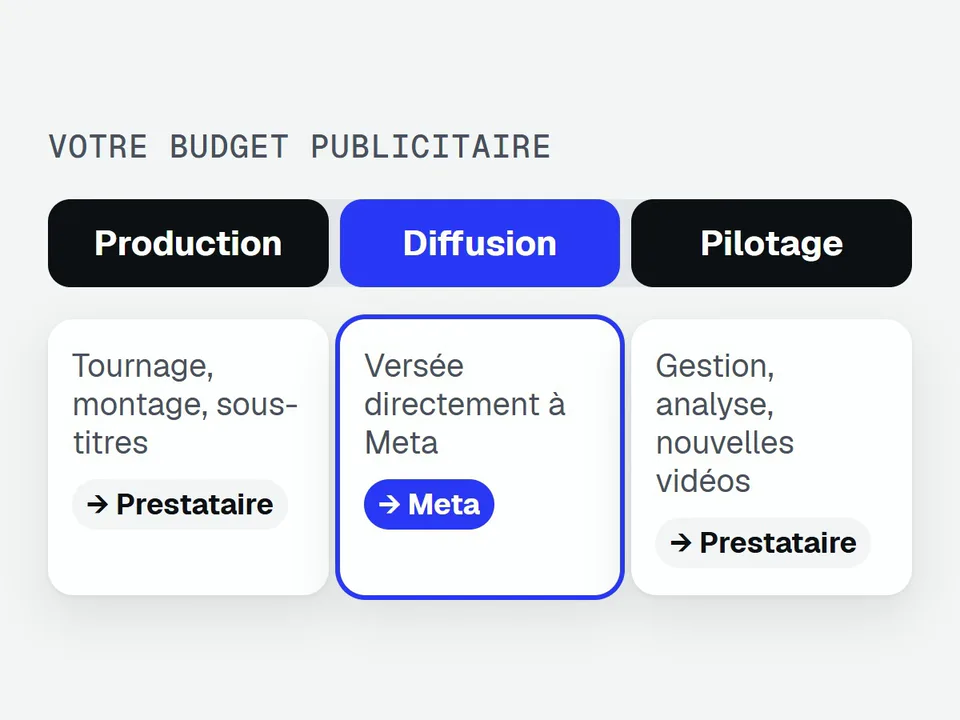
The three cost lines
Production. What you pay to get the video: filming, editing, subtitles, format variations.
Ad spend. What you pay Meta directly so the video gets seen. That money does not pass through your supplier.
Management. What you pay for someone to run the campaigns, read the results and refresh the creative.
A quote that blends the three stops you comparing offers. Always ask for the breakdown.
1. Production
On the French market in 2026, the observed ranges for a short video made for advertising:
| Type of work | Range |
|---|---|
| Short or Reel cut from your own footage | €30 to €150 |
| Worked-up ad video | from €500 |
| Ad video with heavy motion design | up to €3,000 and beyond |
| A day of filming with a camera operator-editor | €380 on average, range €200 to €500 |
| Monthly pack of four formatted videos | around €1,500 |
Those gaps are not irrational. A €50 video assumes clean footage, a clear brief and zero back and forth. As soon as someone has to log the rushes, fix the sound, hunt for cutaways and handle several rounds of feedback, the maths stops working.
The classic trap: paying for one heavily worked video. In advertising, a single video teaches you one thing. Five decent videos testing five different angles beat one perfect video testing one angle.
What about AI-generated video?
Fully generated production changes the equation on volume. Producing ten variants of one idea costs barely more than producing one, because the cost moves from filming to writing and editing. In exchange, you lose what builds trust with a homeowner: a real face, a real voice, a real place.
The combination that works best: film for half a day to have authentic shots, then generate the variants around them.
2. Ad spend
This is the line nobody can guarantee, because it depends on an auction.
The 2026 benchmarks:
- The average CPM jumped around 20 % in a year, from $11.82 to $14.19. (source)
- On lead generation campaigns, the average CPC is $1.80, against $1.92 a year earlier. (source)
- The average cost per lead sits at $27.39, near enough flat over a year. (source)
A word of caution: these are US benchmarks, in dollars, across all industries. They give an order of magnitude, not a target. In home and home improvement, the average cost per lead rises to $42.95, and $39.25 for furnishings, well above the average, because competition is fierce over narrow areas. (source) Only your own account gives you the right benchmark, after a few weeks.
An important point about rising costs: the mass arrival of Advantage+ campaigns simplified bidding, but it also intensified competition for the best placements. Easier access made the space dearer for everyone.
3. Management
Three models exist on the market.
A monthly retainer. The supplier bills a fixed amount to run your campaigns. Simple, legible, but their pay does not move with your results.
A percentage of ad spend. Common in agencies. A structural problem: the supplier earns more when you spend more, regardless of what it brings back.
Fixed plus a variable on results. A base covers the work, a share depends on the appointments or the revenue generated. That is the model that aligns interests best, provided the measurement is clear and shared.
An example of a full budget
For a business starting out:
| Item | First month | Following months |
|---|---|---|
| Half a day of filming | €400 to €600 | every two months |
| Editing 6 ad videos | €900 to €1,800 | €600 to €1,200 |
| Meta ad spend | €1,500 to €3,000 | depending on results |
| Management | varies by model | varies |
The first month always costs more: setting up conversion tracking, the first creatives, the algorithm's learning phase. From the second month, production drops and ad spend becomes the main line.
Three mistakes that blow up the real cost
Launching with a single video. With nothing to compare against, there is no way to know whether the problem is the video, the audience or the offer. You pay for the learning twice.
Cutting a campaign after a week. Even with homeowners, a decision about work or equipment is rarely taken the day the ad is seen: people compare, ask for two or three quotes, talk it over at home. Judging a campaign on seven days is reading the first page of a book.
Not refreshing the creative. Meta now penalises low-engagement ads with a surcharge. A video running too long costs more and more to deliver.
How to think about it
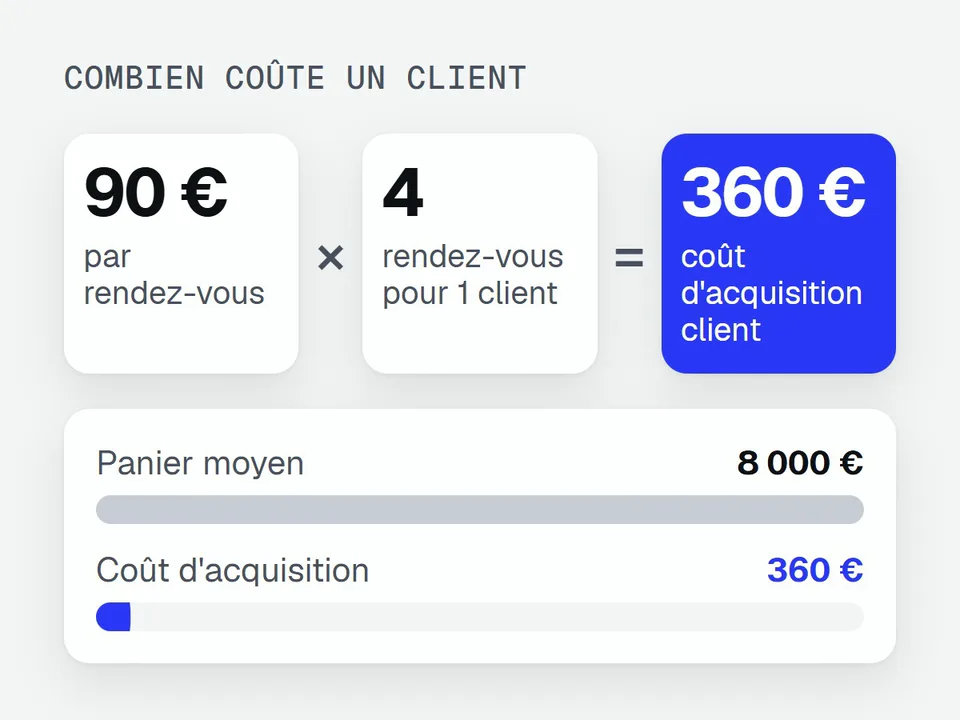
The right question is not "what does this video cost", but "what does a qualified appointment cost me". If your average order value is €8,000 and you get an appointment at €90 with one in four signing, your customer acquisition cost lands around €360. The price of the video becomes secondary.
That is why I measure in appointments obtained and cost per appointment, never in view counts.
Going further: What Meta Ads budget to plan and How to structure a Meta campaign that brings enquiries in.
Want to put numbers on your case? . We look at your offer, your market and set a realistic budget. You leave with a plan, whether we work together or not.