- creatives
- video
- method
Structuring a short video ad: hook, proof, offer, call to action
The four moments of a short video ad and what each must do in a few seconds, illustrated by the three angles tested at a kitchen fitter.
Published on · Joh · 6 min read
A short video ad has very little time. The person watching is scrolling their feed, and decides within seconds whether to stop. Everything you put in the video must serve that decision, then the next one.
Here is the structure I use, and how it reads on a real case.
The four moments
1. The hook. The first seconds. They must stop the scroll: a sentence about a precise problem, an unexpected image, a question the person is asking themselves. If this moment fails, the rest is not seen.
2. The proof. What shows that what you just said is true: a before and after, a job site, a face, a figure that can be checked. A consumer committing money wants to see.
3. The offer. What the person gets, simply: a quote, a visit, an appointment, a monthly payment.
4. The call to action. One action requested, stated clearly. Several requests in one video mean none is remembered.
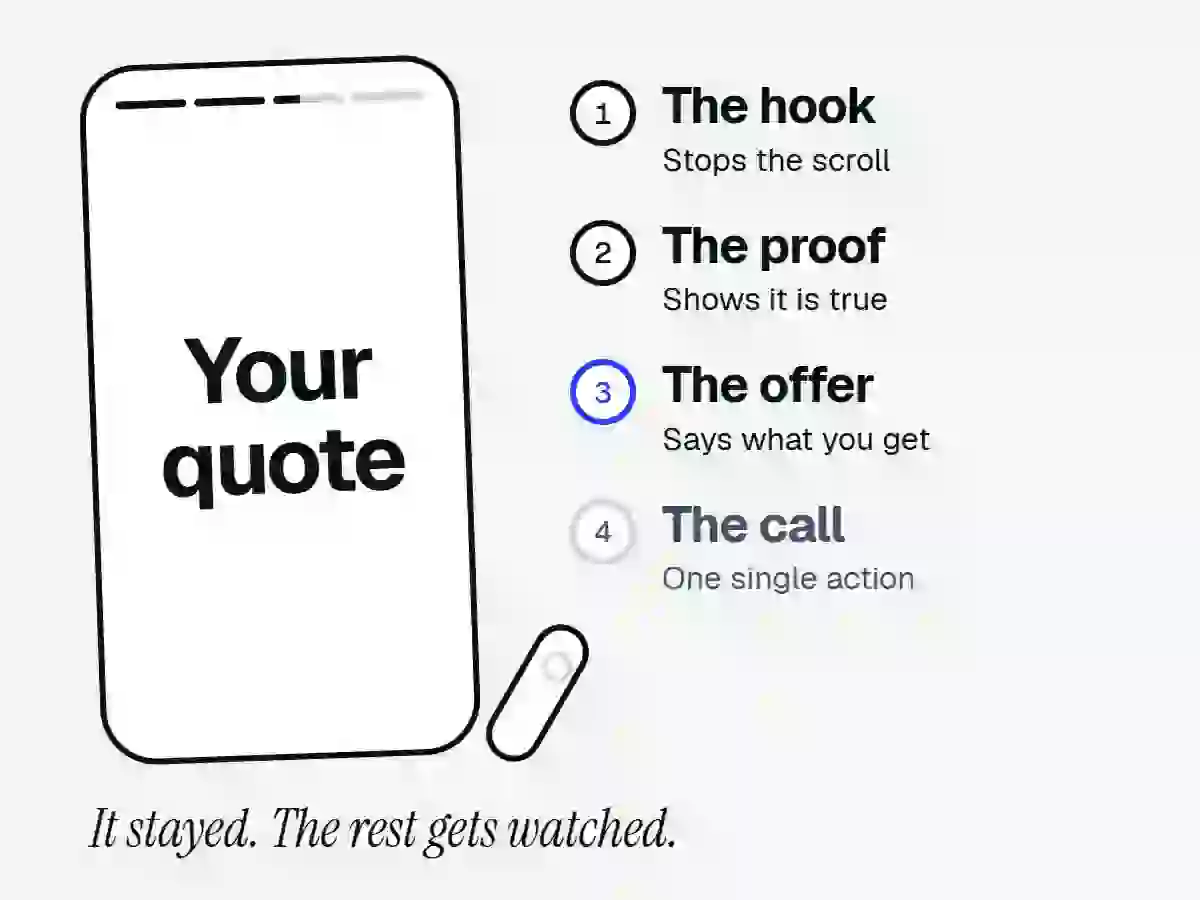
One video, one angle
The frequent mistake is trying to say everything. A video that talks about price, quality, service and warranty persuades of nothing. Each video carries a single angle, and you test several angles rather than polishing one.
What it looks like at a kitchen fitter
On the case published on this site, three angles were tested in parallel from the first month:
- Financing: "your kitchen from €149 a month", for people who did not think a new kitchen was for them.
- Finished work: before and afters filmed at customers' homes.
- The fitter: the owner explaining why a badly fitted kitchen shows after two years.
Three different hooks, three audiences that recognise themselves differently. Each has its moment of proof: the monthly payment, the finished job, the face of the person who fits. The full case.
The format
You shoot and edit vertically, because that is how the video appears in Stories and Reels. A large share of videos is watched without sound: legible subtitles are part of the video, not a detail to add afterwards.
What you look at to judge
Hook rate tells you whether the opening stops the scroll, hold rate tells you whether the rest keeps its promise. Both are explained in the glossary. But what finally decides is the cost of an appointment, not the number of views.
When the video wears out
Even a good video tires. Why costs climb after a few weeks, and why you need to renew the angles and not only the images.
Further reading: UGC advertising: definition and limits and AI video or real filming. For the opening: six hook mechanics, with real examples, and the script template.
Want videos that stop the scroll? . We look at your business and choose the angles to test.