- Meta Ads
- qualification
- method
Facebook instant forms: when they work, and when to prefer your own site
The instant form saves people leaving Facebook and brings in more contacts, sometimes less reliable ones. How to choose against a page on your own site.
Published on · Joh · 6 min read
When you launch a campaign to get enquiries, Meta offers two paths. Send the person to your site, or show them a form without them leaving Facebook or Instagram. The second format is called the instant form, or lead ad.
What it does
The person taps the ad's button, a form opens inside the app, with their name, email or phone number already filled in from their profile. They check it and send it. You need neither a landing page nor a fast site.
What it brings
Little friction. Few gestures are needed to send, so more people do it. And you can start without a site, which matters when you do not want to wait.
What it costs
A contact obtained in one gesture is a less committed contact. Filling in a form that is already prefilled takes less intent than reading a page and choosing to leave your details.
Two consequences show up quickly:
- Contacts who do not pick up, or who no longer remember having asked for anything.
- Prefilled details that are old or wrong, a number that is no longer the right one.
Meta offers a type of form that adds a review step before sending. It lowers the number of contacts and aims to keep the more decided ones.
The questions that sort
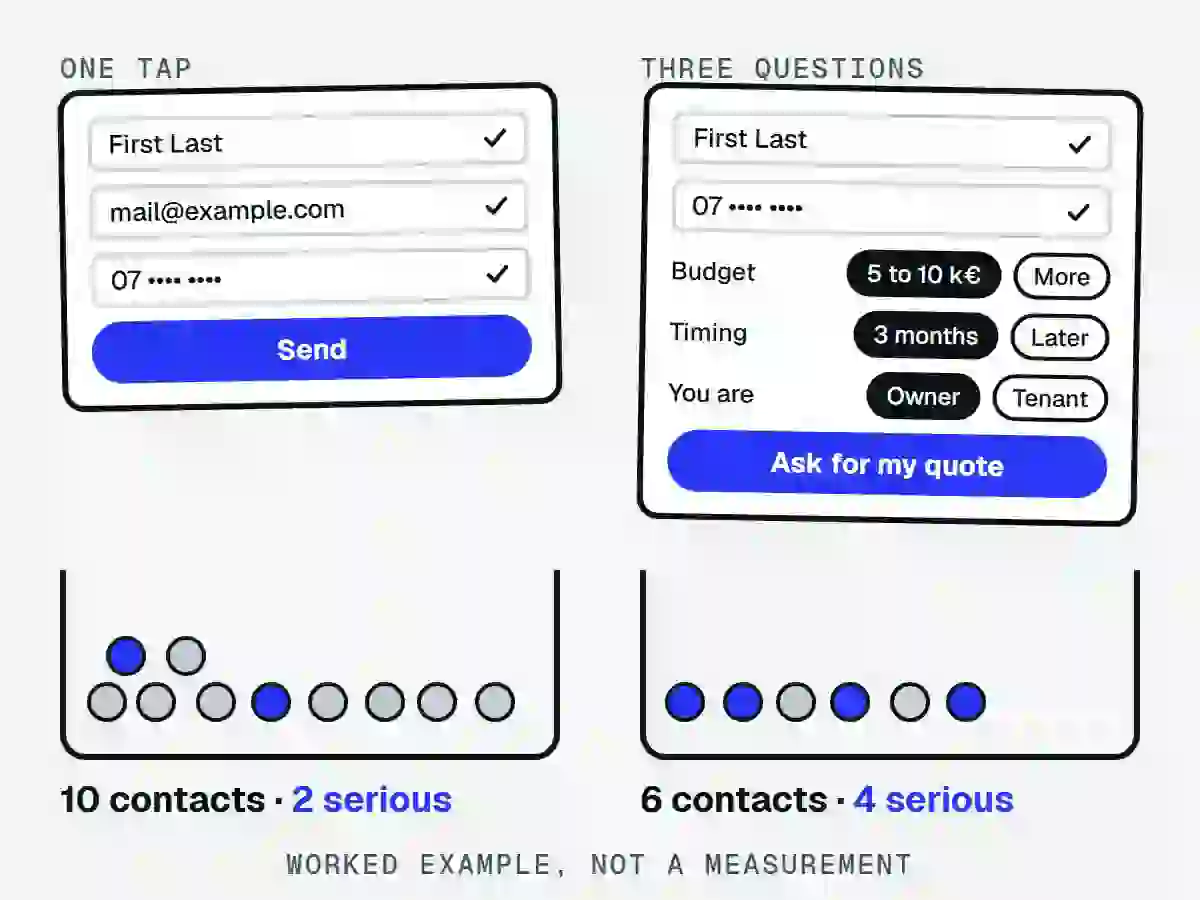
The form accepts questions. Three are often enough to separate people with a project from people browsing: the budget in mind, the timescale, and the situation, for example owner or tenant. At the kitchen fitter whose case is published on this site, those three questions cut volume by 30% and lifted the appointment rate by half. The full case.
Volume falls, quality rises. What remains is deciding which you prefer: ten contacts of which two are serious, or six of which four are.
Callback speed, which decides everything
A contact obtained in one gesture is also a contact that is quickly forgotten. Called within minutes, they remember. Called the next day, they have already seen something else. On the kitchen case, the callback happens within 10 minutes, every time.
Instant form or a page on your site
| Situation | Rather |
|---|---|
| Simple offer, quick purchase, little to explain | Instant form |
| You do not yet have a usable site | Instant form |
| Expensive project that needs reassurance and explanation | A page on your site, with a video |
| You want the person to understand before they ask | A page on your site |
Nothing stops you testing both and comparing, not on cost per contact, but on what arrives at appointment and then at sale. Why cost per contact misleads.
Further reading: How to structure a Meta campaign to get enquiries and the Facebook advertising glossary.
Facebook contacts not answering? . We look at your form and your callback time.